The Hourglass Model (v3) of Organizational AI Governance
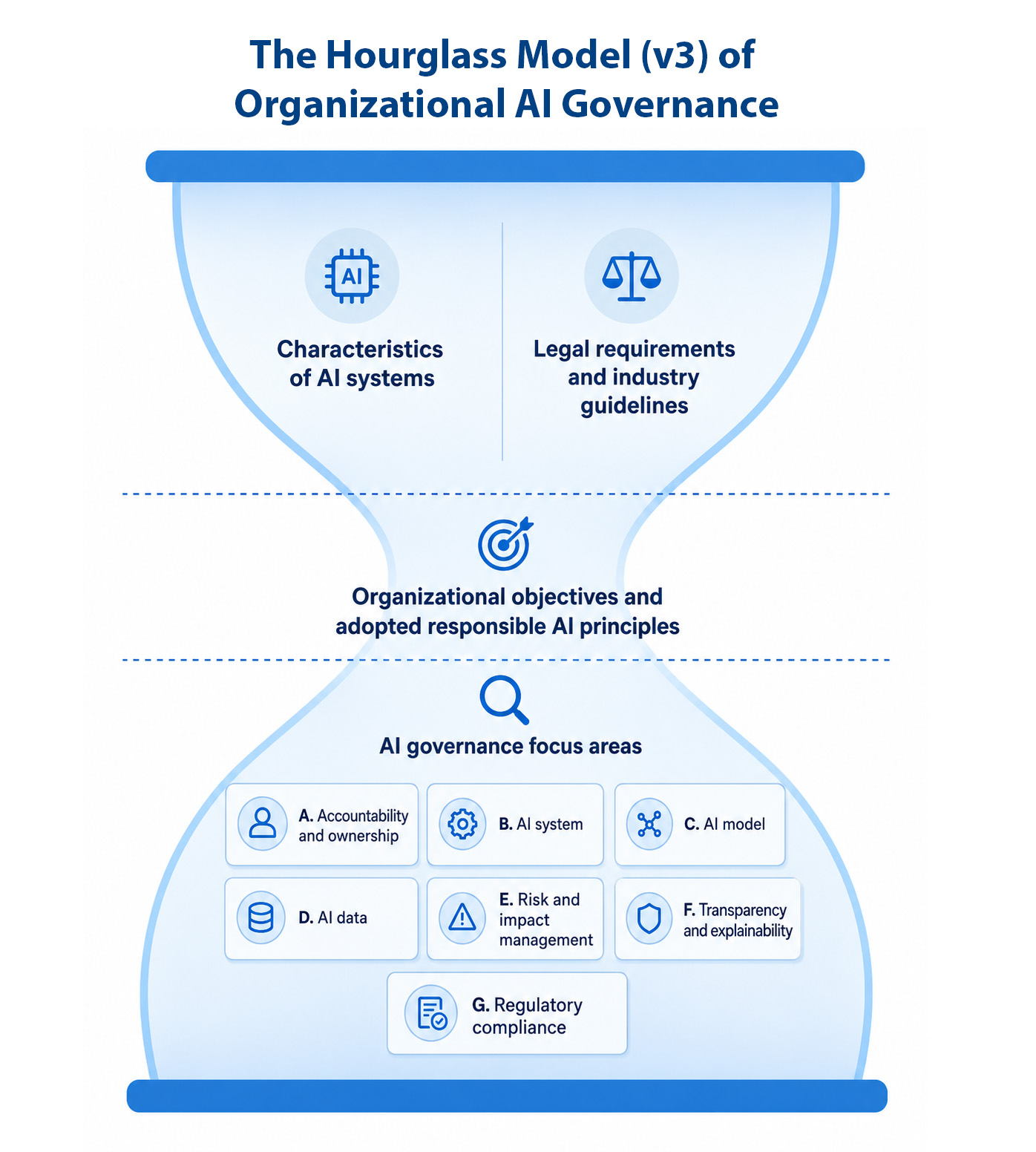
Based on rigorous research with several AI experts, the Hourglass Model (v3) presents the overall structure of the AI Governance Framework. What’s new in v3: • Ecosystem-aware • Vendor-integrated • GenAI-explicit • Human capability embedded • Realistic about explainability • Adaptive and agile
Citation: Mäntymäki, M., Minkkinen, M., Birkstedt, T., & Viljanen, M. (2022). Putting AI Ethics into Practice: The Hourglass Model of Organizational AI Governance (arXiv:2206.00335). arXiv. https://doi.org/10.48550/arXiv.2206.00335
The Hourglass Model (v3) consists of seven designated focus areas (A–G) and related tasks.
Scroll down or click the buttons below to view the focus areas and tasks.
A. Accountability and ownership.Putting in place the decision rights and responsibilities to govern AI systems and models, including an organization-wide AI system registry, human oversight,AI competence, and the integration of AI sourcing and operations with organizational governance.
Tasks within focus area A:
A1. Organization-level accountability
A2. AI system-level accountability
A3. AI system registry
A4. Human oversight
A5. AI competence and training
A6. AI sourcing, operations, and governance integration
B. AI system.Documentation, performance metrics, and approval processes for AI systems. Maintaining AI system documentationproviding a complete view of the organizations’ AI systems and models. Governing AI system vendors including vendor oversight and contractual relationships.
C. AI model.Documentation, performance metrics, and approval processes for AI models. Maintaining documentation on the AI models used by the organization.
D. AI data.Data quality management, data sourcing, performance metrics and control points. Ensuring copyright, intellectual property, and privacy issues related to AI data are handled.
Tasks within focus area D:
D1. Data source documentation
D2. Data copyright, intellectual property, and permissions
D3. Data quality metrics
D4. Data ontologies, inferences, proxies, and metadata
E. Risk and impact management. Identifying, managing, and monitoring potential risks and impacts caused by the AI system. Risks may be related to, e.g., discrimination, misleading content produced by generative AI systems, violations of fundamental rights, safety issues, and foreseeable misuse of AI systems.
Tasks within focus area E:
E1. AI system harms and impacts pre-assessment
E2. Model and GPAI risk assessment
E3. AI system impact metrics design
E4. AI system impact assessment
E5. AI system bias and non-discrimination assurance
F. Transparency and explainability.Ensuring AI systems’ transparency and explainability. Fulfilling requirements coming from regulation and stakeholders. Ensuring vendor transparencyregarding AI products and the use of AI in products and services.
Tasks within focus area F:
F1. Transparency and explainability expectation assessment
F2. Transparency and explainability design
F3. Transparency and explainability validation and assurance
F4. Transparency and explainability monitoring
F5. Periodic transparency and explainability review
G. Regulatorycompliance.Understanding the regulatory environment of an AI system and ensuring its compliance with the relevant regulations (in the EU for example the GDPR, AI Act, national regulations, sector-specific regulations).
Tasks within focus area G:
G1. Regulatory environment assessment
G2. Regulatory risks, constraints, and design parameter analysis
G3. Regulatory design consultation
G4. Compliance assessment, including vendor compliance verification